
Insights

ANALYSIS: Companies need to formalise skin in the game and make transparent minimum shareholding requirements
It has been a tough few years for investors in equities on the NZX. The five-year annualised return of the S&P/NZX 50 Gross Index stood at a measly 0.3% as at 30 April 2026, and almost half the members of the index have posted negative cumulative total returns over that period. Naturally, this has sharpened investor scrutiny of governance practices. While local economic conditions and global geopolitical issues can legitimately be blamed for some of the poor performance, at least some company boards will have faced tough questions at recent shareholder meetings.
Fletcher Building (-49%), Synlait Milk (-87%) and Ryman Healthcare (-82%) are all examples of NZX companies that have seen significant destruction of shareholder value over the last five years1, followed by deep governance resets, which has included substantial board renewal.
The principal-agent problem is fundamental to economics and describes a situation investors know well: the conflicts that can arise between a company’s owners and its managers. That is where the board of directors comes in. Shareholders select qualified candidates to represent their interests and monitor the activities of management.
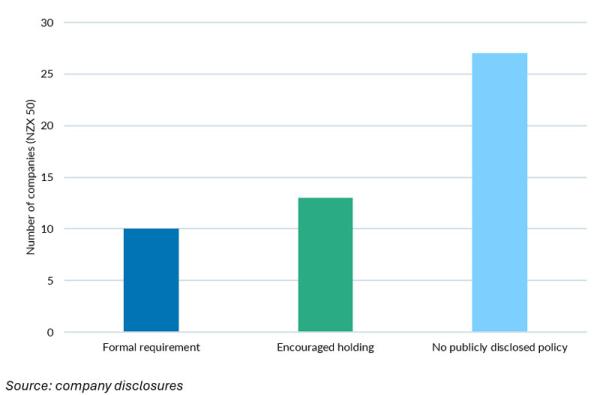
If one of the roles of the board is to represent the interests of investors, should directors themselves be required to be shareholders in the business? Not necessarily in New Zealand. Our analysis finds that only a handful of the largest NZX companies require non-executive directors (NEDs) to hold a certain level of shares, with a further handful encouraging a minimum holding.
Around half of the 50 largest NZX companies have no publicly disclosed policy, nor encouragement, for NEDs to hold shares. We are focused on non-executive directors because executive directors are more likely to already hold shares either directly or through executive remuneration plans.
Other people's money
Concern underlying the agency problem goes back at least as far as Adam Smith’s The Wealth of Nations in 1776. Writing on the topic of joint-stock companies, a forerunner of the modern company, Smith observed:
“The directors of such companies, however, being the managers rather of other people’s money than of their own, it cannot well be expected, that they should watch over it with the same anxious vigilance…”2
In other words, managers without “skin in the game” cannot necessarily be expected to exercise the same care and attention as a company’s shareholders and owners.
Academic literature sets out the roles of a board of directors relatively clearly: to monitor and supervise the executive, while also providing an accountability mechanism to shareholders. The board appoints the CEO; shareholders appoint the board. Boards are not only backward-looking, of course. They also play an essential role in strategy formulation and policy making3.
Director share ownership is not just symbolic, it helps align directors with shareholders, making sure they are also ‘at risk’ for poor decisions and encourage thinking long-term about capital allocation, risk, remuneration and strategy.
Our analysis
For our analysis, we reviewed the public disclosures of NZX 50 companies. We do not claim the analysis is perfect, and there is certainly some subjectivity in the results. It is based on publicly available disclosures so will not capture internal policies. Nevertheless, we think the findings are interesting and indicative of broader trends.
We found that ten NZX companies have some form of formal requirement for NEDs to hold shares in the company, while a further 13 encourage NEDs to own shares. Among these 23 companies, there were various combinations of minimum holding amounts and time horizons over which NEDs were expected to build their shareholdings.
Findings from our analysis of company disclosure on director shareholding requirement
Here are some examples that stood out to us. There were many other good examples, but we have selected a few to illustrate the different approaches:
Auckland International Airport requires directors to use at least 15% of their net fixed base annual director fee each year for three years to acquire shares, until their holding is at least equivalent to one net fixed base annual fee.
Ryman Healthcare introduced a formal requirement in 2023 as part of its closely watched governance reforms. The policy requires NEDs to hold a minimum shareholding equivalent to the value of their base director fee within the first five years of appointment. NBR reported on a flurry of share buying by Ryman NEDs in August last year.
Contact Energy “encourages” directors to hold at least 20,000 shares within three years of appointment, subject to personal circumstances. At the current share price, this would be close to $200,000 in value.
Another approach is taken by NZX Limited, which has a formal share purchase plan requirement tied to director remuneration. NZX directors must use a portion of their fees to buy shares in the company: 50% of the Chair fee above $100,000, and 50% of Director fees above $50,000, unless they are not permitted to do so for compliance or other reasons.
From our perspective, whether the expectation is framed as a formal requirement or an encouragement is less important than whether it is written down in policy. A disclosed policy sets a strong expectation that NEDs will hold shares in the companies they serve, subject, of course, to appropriate exceptions.
Director ownership is not always straightforward
An essential attribute of a NED is independence. A majority-independent board is generally a preference among investors globally, including ourselves. There is certainly a level of share ownership at which a director is no longer independent, therefore, some may argue that it is acceptable for NEDs not to hold any shares. We disagree and we think most minority investors would hold this position. Our view is that there is a level of share ownership that aligns NEDs with long-term shareholders while still preserving their independence.
Another concern is that share ownership could heighten focus on short-term share price performance rather than long-term value creation. Further, we do not want to see a situation where an otherwise qualified and suitable candidate is unable to become a director because they cannot purchase the minimum required number of shares due to personal circumstances. If this leads to boards that have less diversity of thought and opinion, we believe this would also be a suboptimal outcome for shareholders.
Skin in the game
As investors, we look to boards to keep management accountable and make decisions for the long-term benefit of the company. In our view, it is reasonable for long-term shareholders to expect NEDs to have some economic exposure to the companies they oversee, subject to appropriate exceptions.
We think this expectation should be made clear to potential directors, either through a formal policy requirement or a publicly disclosed expectation.
As discussed earlier, one part of Ryman’s deep governance reset was the introduction of a formal minimum shareholding requirement for NEDs, seen as a step in rebuilding investor confidence.
Infratil, which has been a bright spot on the NZX, providing investors around +100% total return4 over the last five years, encourages directors to acquire and hold shares in its Board Charter.
Infratil insiders, including several NEDs, were notably buying up the stock last year, a signal to shareholders of confidence in the future of the company.
Investors can already see in company annual reports whether directors hold shares. The next step is for more companies to make clear whether they expect their directors to do so.
1Cumulative Total return for the five years to 30 April
2Adam Smith, An Inquiry into the Nature and Causes of the Wealth of Nations (1776), Book V, Chapter I, Part III, Article I.
3Definition from Hilmer, F. G., & Tricker, R. I. (1991) Directors and Boards: Their Role and Structure
4Cumulative Total return for the five years to 30 April
Disclaimer: This article has been prepared in good faith based on information obtained from sources believed to be reliable and accurate. This article does not contain financial advice. Some of the Octagon portfolios may own securities issued by companies mentioned in this article.
Octagon Asset Management is the investment manager for Octagon Investment Funds and the Summer KiwiSaver scheme.